
Gliadin and Gluten test kits
Gluten test kits for gluten detection in food
Gluten detection in food – Measurement of Gliadin or Gluten in foods
Why is gluten detection in food important and how can our gluten test kits help you?
People with celiac disease must follow a strict gluten-free diet. With increasing awareness of gluten sensitivity and a broader trend towards health-conscious eating, more consumers are avoiding gluten. Therefore, reliable gluten-free labeling is crucial. Manufacturers must ensure their products comply with legal limits. Testing food and equipment for traces of gluten is a core task in quality control. Validated gluten test kits are essential tools for maintaining product safety and quality. With the largest range of gluten test kits, we are your reliable partner for quality control – whether for incoming goods inspection, in-process control, hygiene control, or end-product confirmation. Find the most suitable gluten test kits for your needs and integrate gluten testing into your food production process.
Which gluten detection method to choose – Lateral flow test, ELISA or PCR for gluten analysis?
We offer probably the broadest range of gluten test kits – but which method to choose? Which gluten detection method is the right choice for your needs? We have summarized the different options for you:

Gluten Lateral Flow Devices (LFD’s)
Testing raw materials for the presence of gluten with gluten test strips is an essential step. Next, ensuring your production environment is free from gluten contamination is crucial. And finally, testing your finished products as verification for gluten is important.
Lateral Flow Devices (LFDs), like gluten test strips, offer a fast, simple, and cost-effective solution to manage the risk of gluten cross-contamination. These tests allow for immediate on-site testing, significantly reducing the time to market for food product batches. With only a few minutes of incubation required, LFDs provide convenient and effective monitoring at various stages of food production. This includes testing food matrices, rinse water, surfaces, and equipment. Additionally, traces of gluten contamination in your laboratory can be easily detected with LFDs.
- Only available gluten lateral flow based on R5 antibody.
- Quantitative and qualitative gluten detection.
- High specificity and sensitivity.
- Rapid and straightforward, no specialized training or equipment needed.

Gluten Enzyme-Linked Immunosorbent Assay (ELISA)
ELISA is the standard method for gluten detection, known for its high sensitivity and specificity. It enables precise quantification of gluten proteins in complex food matrices, ensuring adherence to regulatory requirements. With our broad portfolio we offer solutions for every customers need (overview see below).
Besides our RIDASCREEN® Gliadin, which is Codex Alimentarius Method Type I, all other immunoassays, including the gluten strips, are also based on the R5 antibody! Consequently, the immunological reactivity pattern is similar and therefore, results are comparable and traceability to the Codex-method is given. This ensures consistent results along the whole food production chain (from grain suppliers to final food production) and allows considering specific analytical situations regarding rapidness, easiness or food specialties.

Polymerase-Chain-Reaction (PCR) for gluten detection:
PCR testing complements ELISA results and can be used both qualitatively and quantitatively. All qPCR kits feature a standardized sample and test procedure, with options for semi-automated sample preparation available.
The unique SureFood® ALLERGEN 4plex Cereals (Art. No. S7006) kit differentiates between cereal species, including wheat, barley, and rye, offering a versatile tool for comprehensive gluten analysis. The SureFood® ALLERGEN Gluten qPCR (Art. No. S3606) kit detects gluten containing cereals without differentiation. Quantification based on DNA, with subsequent conversion with the laboratory reference material Quantard 40 (containing wheat type 405) is possible in mg/kg of total wheat amount – but not to gluten protein amount.
Product overview: Gluten test kits
You can find a comprehensive overview of our gluten test kits in our free brochure.
Key benefits of monitoring gluten in food
- Consumer protection: Ensures that individuals with celiac disease or gluten intolerance can safely consume food products labeled as gluten-free, protecting them from adverse health effects.
- Regulatory compliance: Helps manufacturers meet gluten-free labeling regulations, ensuring that products comply with legal standards and are safe for sensitive consumers.
- Quality assurance: Maintains the integrity and safety of gluten-free products by accurately detecting and quantifying gluten levels, preventing contamination.
- Comprehensive testing: Utilizes a range of sensitive and specific test methods, including lateral flow tests for surface swabbing and ELISA tests for ingredient and product analysis, to ensure thorough monitoring of gluten presence.
- Efficiency and reliability: Provides fast, reliable results that support efficient quality control processes and timely product release.
R-Biopharm – your specialist in gluten analysis
R-Biopharm has more than 20 years of experience in the field of gluten analysis in foods. In 2002, we launched the first commercially available R5 ELISA, RIDASCREEN® Gliadin. The assay was developed according to the R5 ELISA method in combination with a special cocktail extraction procedure for heat-processed samples, which has been developed and published by Professor Méndez. The cocktail is available at R-Biopharm as Cocktail (patented).
In 2003, this R5-ELISA in combination with the Cocktail (patented) was endorsed as Codex Alimentarius Type I method. This combination is currently only commercially available from R-Biopharm. In 2012, the AOAC adopted the combination of RIDASCREEN® Gliadin and Cocktail (patented) as Official Method of AnalysisSM First Action number 2012.01. In 2020, we conducted a new collaborative study to acknowledge the methods wide applicability for foods from all food product groups. A special focus of this study was the inclusion of incurred samples where the containing gluten proteins were exposed to different food processing conditions. In 2021, the AOAC extended the method’s scope to an “in foods” applicability. This scope is unique!
Since the Codex Alimentarius Type I method is laborious and does not fit to all customer needs, we have developed different methods based on the R5 ELISA. These assays offer specific analytical solutions (e.g. hydrolyzed gluten, faster, more sensitive) and fulfil all kind of customers’ needs.

Please also have a look at our Youtube-Channel, where we offer various insights to our products.
Product portfolio
| Product | Description | No. of tests/amount | Art. No. |
|---|---|---|---|
| RIDASCREEN®EASY Gluten |
Fast and easy ELISA test method for gluten detection! Ensures a safe, fast and easy quantitative analysis of gluten residues from wheat, rye and barley within 30 minutes, delivering results that are in line with the Codex Alimentarius Type I Method … Read more |
Microtiter plate with 96 wells (12 strips with 8 removable wells each) | RAE7071 |
| RIDASCREEN® Total Gluten |
Specialty ELISA test method for gluten detection in oats! Ensures safe quantitative analysis of gluten residues from gluten-containing cereals (wheat, rye and barley) in oat and oat products. RIDASCREEN® Total Gluten is a sandwich enzyme immunoassay … Read more |
Microtiter plate with 96 wells (12 strips with 8 removable wells each) | R7041 |
| RIDASCREEN®FAST Gliadin sensitive |
Fast and sensitive ELISA test method for gluten detection Ensures a safe, fast and sensitive quantitative analysis of gluten residues from gluten containing cereals (wheat, rye and barley). RIDASCREEN®FAST Gliadin sensitive is a R5-based sandwich … Read more |
Microtiter plate with 96 wells (12 strips with 8 removable wells each) | R7051 |
| RIDASCREEN® Gliadin |
Reference ELISA test method for gluten detection! Ensure safe quantitative analysis of prolamins from wheat (gliadin), rye (secalin) and barley (hordein) in food with the reference method. The RIDASCREEN® Gliadin in combination with the Cocktail … Read more |
Microtiter plate with 96 wells (12 strips with 8 removable wells each) | R7001 |
| RIDASCREEN® Gliadin competitive |
Specialty ELISA test method (competitive) for gluten detection in fermented and hydrolyzed food! Ensures safe quantitative analysis of prolamine peptide fragments from wheat (gliadin), rye (secalin) and barley (hordein) in fermented or hydrolysed … Read more |
Microtiter plate with 96 wells (12 strips with 8 removable wells each) | R7021 |
| RIDASCREEN®FAST Gliadin |
Fast ELISA test method for gluten detection! Ensures a safe and fast quantitative analysis of prolamins from wheat (gliadin), rye (secalin) and barley (hordein) in food. RIDASCREEN®FAST Gliadin is a sandwich enzyme immunoassay for the quantitative … Read more |
Microtiter plate with 48 wells (6 strips with 8 removable wells each) | R7002 |
| Product | Description | No. of tests/amount | Art. No. |
|---|---|---|---|
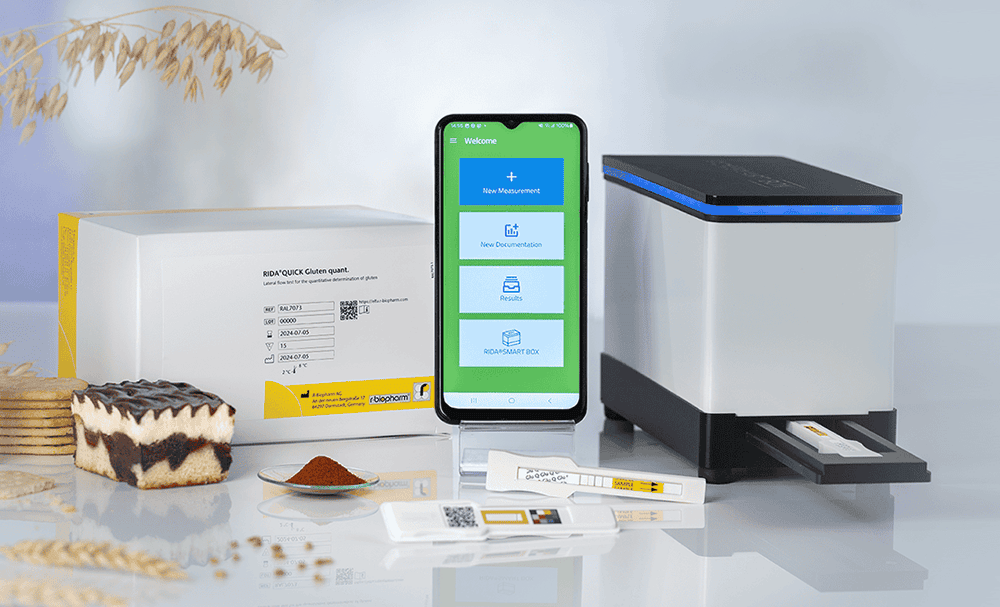
| RIDA®QUICK Gluten quant. |
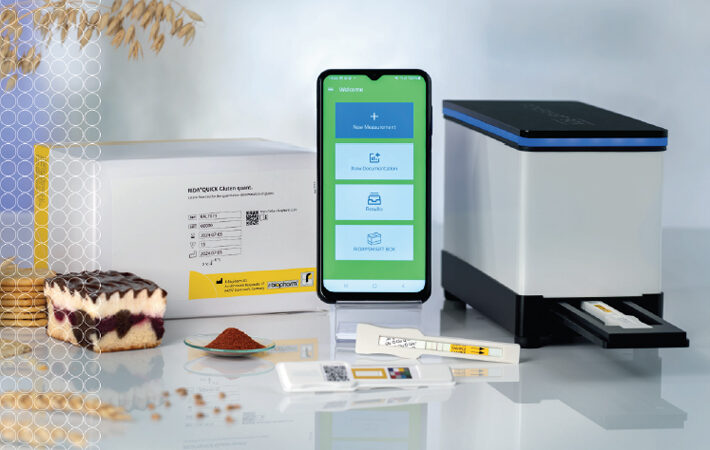
Fastest and most simple quantitative LFD method for gluten detection! Ensures a safe, fast and simple quantitative analysis of gluten residues from wheat, rye and barley on surfaces, in clean-in-place (CIP) water and in foods (raw and processed) in … Read more |
15 test strips | RAL7073 |
| RIDA®QUICK Gliadin |
Fast and simple qualitative LFD test method for the detection of gluten! Ensures safe, fast and simple qualitative analysis of gluten on surfaces, in clean-in-pace (CIP) water and food (raw and processed). RIDA®QUICK Gliadin is an R5-based … Read more |
25 x test strips | R7003 |
| RIDA®QUICK Gliadin (single packaged) |
Fast and simple qualitative LFD test method for the detection of gluten! Ensures safe, fast and simple qualitative analysis of gluten on surfaces, in clean-in-place (CIP) water and food (raw and processed). RIDA®QUICK Gliadin (single packaged) is … Read more |
25 x test strips (single packaged) |
R7004 |
| RIDA®QUICK Gliadin (ready to swab) |
Fast and simple qualitative LFD test method for the detection of gluten by direct swabbing of surfaces! Ensures safe, fast and simple qualitative analysis of gluten on surfaces and in clean-in-pace (CIP) waters. The kit variant RIDA®QUICK Gliadin … Read more |
25 x test strips (single packaged), 25 prefilled vials with ready-to-use sample buffer, for 25 determinations |
R7005 |
| Product | Description | No. of tests/amount | Art. No. |
|---|---|---|---|
| SureFood® ALLERGEN 4plex Cereals |
The SureFood® ALLERGEN 4plex Cereals is a multiplex real-time PCR test for the direct, qualitative detection and differentiation of specific wheat (Triticum), barley (Hordeum vulgare) and rye (Secale cereale) DNA sequences in food. Each reaction … Read more |
100 reactions | S7006 |
| SureFood® ALLERGEN Gluten |
The SureFood® ALLERGEN Gluten is a real-time PCR for the direct, qualitative and / or quantitative detection of specific gluten-containing cereals including wheat (Triticum spp.), rye (Secale cereale), barley (Hordeum vulgare) and oat (Avena sativa) … Read more |
100 reactions | S3606 |
FAQ
Celiac disease is a chronic autoimmune disorder in which the body reacts to gluten. Gluten is a protein found in grains such as wheat, rye, and barley. In people with celiac disease, the immune system attacks the lining of the small intestine after consuming gluten. This damages the intestinal villi, which severely impairs the absorption of nutrients.
Typical symptoms include diarrhea, abdominal pain, flatulence, weight loss, fatigue, and, in children, growth disorders.
Celiac disease is not an allergy, but an autoimmune disorder. The only effective treatment is a strict, lifelong gluten-free diet.
Celiac disease: Autoimmune disorder
When gluten is consumed, the immune system attacks the lining of the small intestine. This damages the intestinal villi, which can lead to nutrient deficiencies and chronic symptoms in the long term.
Food allergy: An overreaction of the immune system to certain proteins in foods, e.g., nuts or milk. Symptoms often occur very quickly and range from skin reactions to anaphylaxis.
Gluten is a protein mixture consisting of gliadin and glutenin found in wheat, rye, and barley.
Definition: Gluten consists of the storage proteins gliadin and glutenin.
Occurrence: Wheat, rye, barley, hybrid grains (e.g., kamut, triticale).
Function: Gives dough elasticity, provides the typical texture of bread and pastries.
Health:
- Celiac disease: gluten-related autoimmune disease
- Wheat allergy: reaction to other wheat proteins
- Non-celiac gluten sensitivity: symptoms without autoimmune reaction
Labeling: Food packaging must declare ingredients containing gluten (EU: LMIV Annex II, other countries have their own regulations)
Gluten is a collective term for certain proteins (gliadin and glutenin) found in some types of grain. The most important gluten-containing grains are:
- Wheat (all varieties including spelt, emmer, and einkorn)
- Rye
- Barley
- Kamut
- Triticale (a cross between wheat and rye)
These grains are often found in bread, pasta, baked goods, and many ready-made products. People with celiac disease, gluten sensitivity, or wheat allergy should avoid these grains or only consume them in gluten-free form.
Oats are naturally low in gluten, but can often be contaminated with gluten during processing and are only considered gluten-free if labeled as such.
Yes, the proteins differ in structure and effect.
- Wheat: Gliadins and glutenins
- Rye: Secalins
- Barley: Hordeins
- Oats: Avenins
The avenins in oats differ structurally from other gluten proteins. Pure, uncontaminated oats are tolerated by most people with celiac disease.
There are globally recognized limits for gluten in food, which are primarily intended to protect people with celiac disease.
Internationally, many countries follow the Codex Alimentarius (FAO/WHO). This stipulates that a food product is only considered gluten-free if it contains a maximum of 20 mg of gluten per kg food (20 ppm) (Codex Standard 118-1979). It is based on clinical studies that show that this amount is safe for most people with celiac disease.
This limit is also implemented in many countries, including the EU, USA (FDA), Canada, Australia, New Zealand, and numerous other countries.
For the analysis of gluten in food, different test systems are used, each with its own sensitivity and application range:
ELISA (enzyme immunoassay):
- most commonly used method in routine diagnostics
- detects specific allergenic proteins (the allergy‑triggering components)
- quantitative results
- R5-ELISA in combination with the Méndez-Cocktail is the reference method according to Codex (CODEX STAN 234-1999)
Rapid tests (lateral flow tests):
- primarily used on‑site for testing raw materials or production lines
- provide fast qualitative or quantitative results
PCR methods (DNA‑based tests):
- Distinction between gluten species
- detect DNA from gluten‑containing ingredients, even when the proteins have been altered by processing (SureFood® ALLERGEN 4plex Cereals)
- Multiplexing possible
Mass spectrometry (LC‑MS):
- highly specific
- can identify proteins and peptides even in heavily processed foods
- requires significant effort and cost
- demands extensive technical expertise
- involves complex sample preparation
-> used only rarely within allergen management
Yes, there is a recognized reference method.
The R5-Méndez method was defined as a Type I method for gluten determination in Codex Alimentarius Standard CXS 234-1999. The R5-Méndez method is a combination of an R5 antibody sandwich ELISA and the special Méndez cocktail for extracting gluten from heat-treated foods. A collaborative study published in 2003 using the R5-based RIDASCREEN® Gliadin ELISA in combination with the Cocktail (patented) – the Méndez cocktail – formed the basis for the Codex Alimentarius Committee’s decision. The CODEX STAN cites the publication „Clin. Gastroenterol Hepatol. 2018 Jun;16(6):823-836“ which refers to the international collaborative study using R5 ELISA and the Cocktail (patented).
The sandwich ELISA is part of the reference method. An ELISA is used when allergens in food need to be detected quantitatively. ELISA detects proteins and provides accurate concentration values. It is ideal for laboratory analyses, quality assurance, and traceability of raw materials or finished products. Heavily processed foods can make protein detection more difficult.
For example, gluten proteins in food products can be quantitatively determined using RIDASCREEN® Gliadin (reference method) or RIDASCREEN®EASY Gluten.
An LFD (lateral flow device / rapid test) is used when quick results are required. For example, it can be applied directly during incoming goods inspection of raw materials, for hygiene monitoring of production lines, for testing rinse water, or for on‑site product checks. LFDs are easy to use and provide qualitative or quantitative results within minutes.
With the qualitative RIDA®QUICK Gliadin, surfaces can be wiped directly with the strip, for example. The RIDA®QUICK Gluten quant. enables quantitative evaluation.
- RIDASCREEN® Gliadin (Art. No. R7001): Codex type I method (reference method) and best validated method; applicability for food in general
- RIDASCREEN®EASY Gluten (Art. No. RAE7071): Easiest extraction and most rapid ELISA method (30 min incubation time)
- RIDA®QUICK Gluten quant. (Art. No. RAL7073): Quantitative LFD – most rapid and most simple immunological method (no lab equipment needed)
- RIDASCREEN® Total Gluten (Art. No. R7041): Specialty ELISA method for oats
- RIDASCREEN® Gliadin competitive (Art. No. R7021): Specialty ELISA method (competitive) for fermented and hydrolyzed food
- RIDA®QUICK Gliadin (Art. No. R7003/R7004/R7005): Simple qualitative LFD, which can be directly used for swabbing (no lab equipment needed)
- Surefood® ALLERGEN 4plex Cereals (Art. No. S7006): Differentiation between cereal species, including wheat, barley, and rye.
- SureFood® ALLERGEN Gluten qPCR (Art. No. S3606):Detection of gluten containing cereals without differentiation
Food products consist of many different components such as fats, carbohydrates, and proteins, as well as vitamins and trace elements. Since each food has a different composition, this so‑called matrix can influence the analysis of gluten. Such matrix effects may be unspecific (e.g., interferences) or specific (e.g., cross‑reactions with the test system).
In addition, processing steps can alter the structure of proteins that are detected in immunological tests (e.g. fermentation, as in beer production, can break down proteins).
In principle, any food can be tested for gluten, but it must first be evaluated to ensure it is suitable for the specific test system before being used in routine analysis. It is particularly important that the sample is homogeneous, meaning well mixed, to achieve reliable results.
In principle, gluten can also be detected in hydrolyzed and fermented foods. However, it must be taken into account that proteins may be partially or completely broken-down during hydrolysis or fermentation. Immunological tests can only recognize these altered structures under certain conditions.
In sandwich ELISAs (antibody-antigen-antibody), only larger protein fragments containing at least two epitopes can be detected. If proteins are broken-down into many small fragments, they can only be detected using competitive test systems, where a single epitope is sufficient for recognition.
The RIDASCREEN® Gliadin competitive is available for the analysis of hydrolyzed or fermented foods. It also detects small peptides, such as those produced in hydrolyzed/fermented foods.
So-called incurred samples are food samples in which the gluten is intentionally incorporated into the product before processing. Unlike spiked samples, where the gluten is added only to the finished end product, the gluten in incurred samples pass through the entire manufacturing process of a food.
This approach realistically simulates natural contamination during production. Because proteins undergo structural changes during processing steps such as mixing, heating, baking, roasting, or fermentation, these changes affect how well they can be detected by a test method. For this reason, incurred samples are considered realistic and representative test materials.
Official bodies such as the AOAC also recognize the importance of incurred samples and updated their guidelines for validating immunological test systems for food allergens accordingly in 2023.
The RIDA®QUICK Gluten quant. and RIDASCREEN®EASY Gluten test systems have been validated according to the latest AOAC guidelines using incurred samples. As part of an extensive matrix extension, RIDASCREEN® Gliadin was also tested with incurred samples and, based on this, received the unique AOAC-Official Methof of AnalysisTM claim “in foods” from the AOAC.