
Enzymatic assays
Precise and specific measurement of food compounds
Enzymatic assays: From single to high-throughput testing
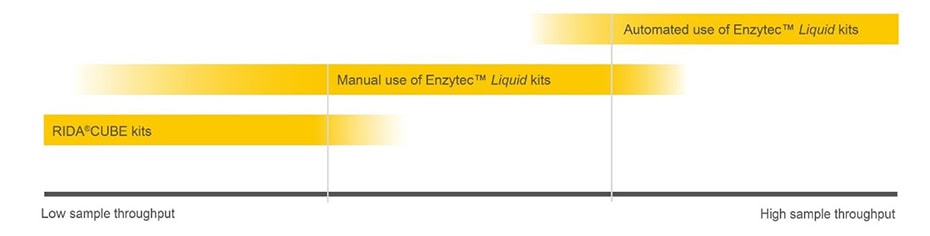
Discover the versatility of enzymatic test kits in analysing wines, fruit juices, and dairy products. At R-Biopharm AG, we understand the diverse needs of our customers, ranging from small- to large-scale industrial labs. Our offerings include:
For single testing
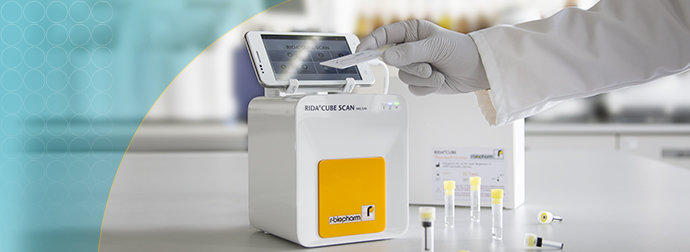
Effortless testing with RIDA®CUBE Kits: Ideal for settings without a lab, these kits require just one pipetting step. Utilize the RIDA®CUBE SCAN for results in 15 minutes. Experience simplicity with pre-filled cartridges and the assurance of precise, quantitative outcomes.
For low to medium throughput
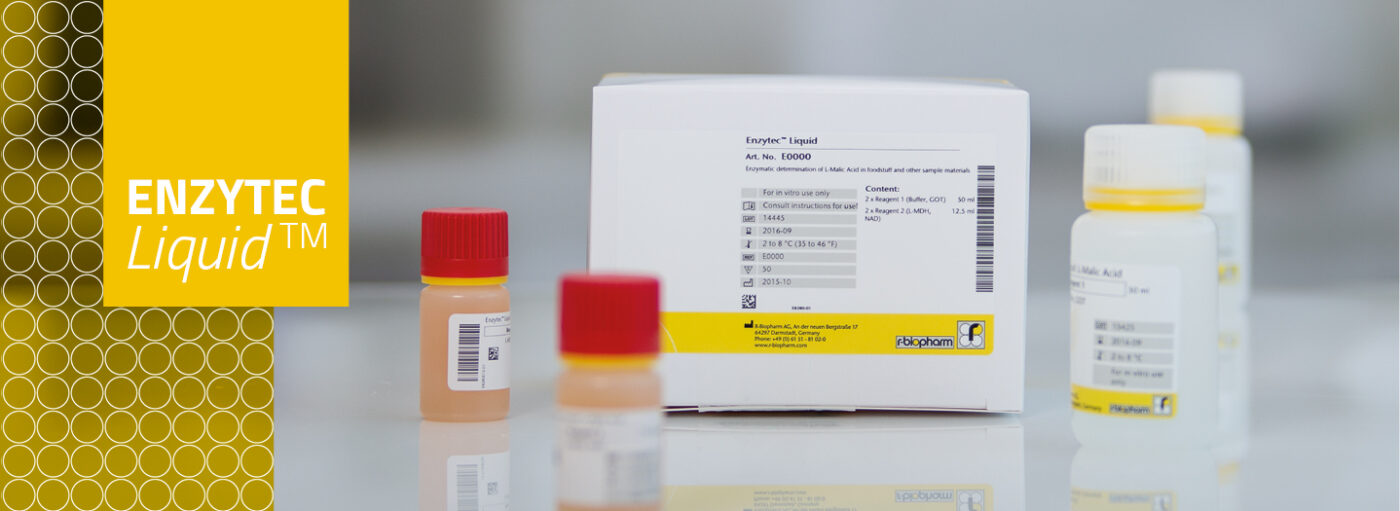
The distinctive features of the Enzytec™ Liquid kits are ready-to-use, stable reagents and a standardized testing procedure, involving only three pipetting steps. Furthermore, Enzytec™ Liquid contains two independent sets of reagents to lower risk of contamination.
For medium to high sample throughput
Flexibility with Enzytec™ Liquid kits: Optimized for both manual and automated use, these kits are compatible with any analyzer, such as the Pictus 500, leading to high-volume testing efficiently.
Unique highlights of our modern Enzytec™ Liquid product line:
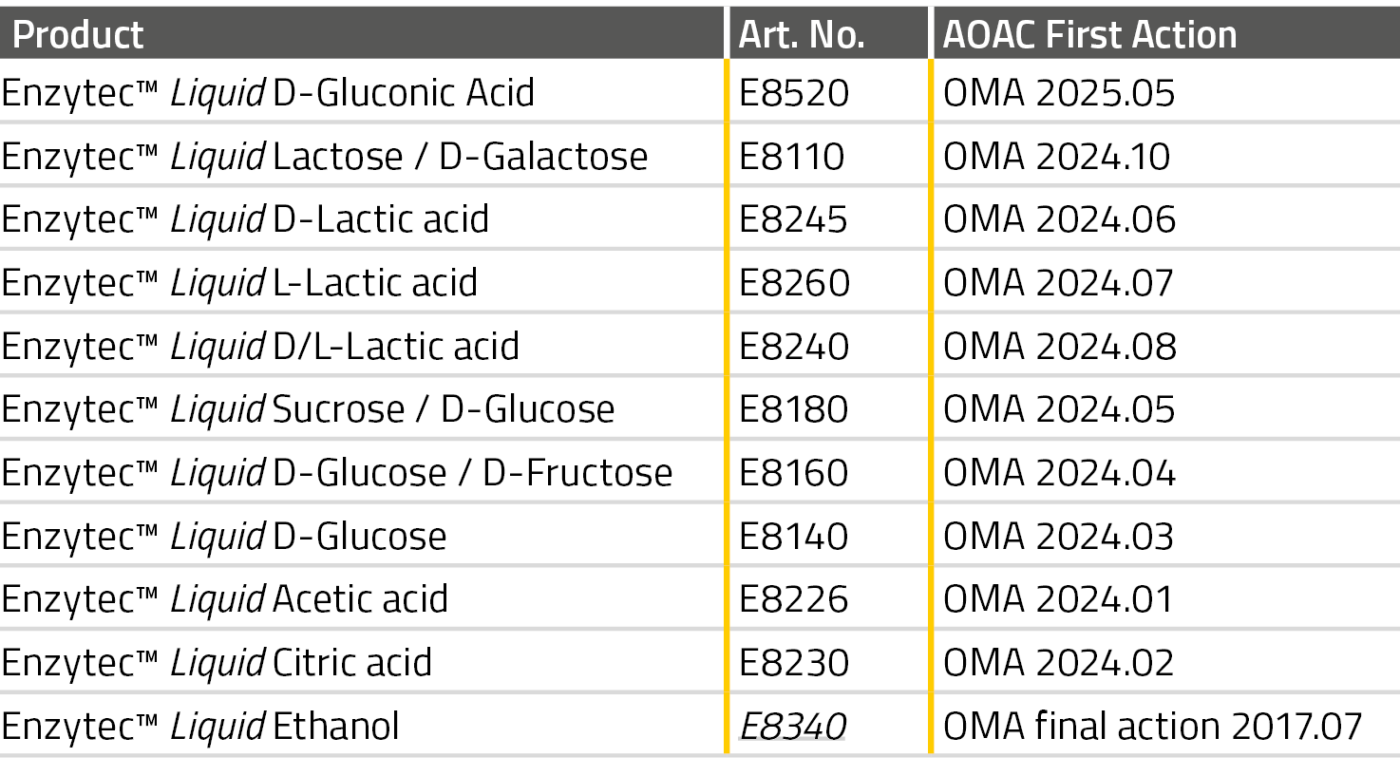
Enzytec™ Liquid Ethanol: Recognized as the AOAC-Official Method of Analysis (2017.07) and recommended by theo Codex Alimentarius Method (Type IV).
The following products in the Enzytec™ Liquid line are also recognized as AOAC-Official Method of Analysis (OMA):
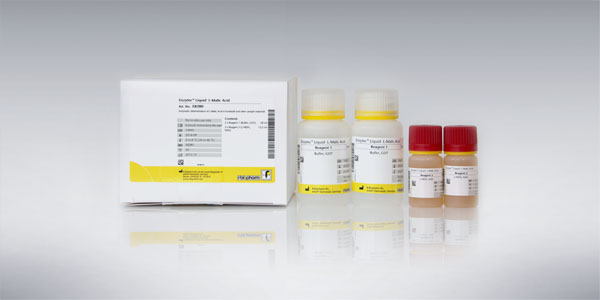
Enzytec™ Liquid Citric Acid: The only citric acid test kit world-wide with stable, liquid reagents.
Our Enzytec™ Liquid Multi-acid standards and Enzytec™ Liquid Multi-sugar standards contain 7 acids or sugars at different concentrations: low and high. These external multi-acid and multi-sugar standards ensure accuracy and cost-effectiveness of enzymatic testing.
Explore our range and find the perfect solution for your enzymatic testing needs!
Enzymatic analysis product overview
You can find a comprehensive overview of our enzymatic test kits in our free brochure.
Enzymatic tests for food analysis
Enzymatic tests are essential analytical tools used for the determination of sugars, acids, alcohols, and other food components in a wide range of products, including fruit juices, wine, beer, dairy products, eggs, and meat.
FAQ
Enzymatic analysis is a highly selective, quantitative method for determining specific components such as sugars, alcohols, or organic acids. It is used in fields where precise and reproducible measurement results are required.
Typical applications include:
- Food and beverage analysis
- Pharmaceutical quality control
- Biotechnological and fermentation processes
The Enzytec™ Liquid line is designed for liquid, ready-to-use reagents, thereby simplifying the analytical workflow.
Key features include:
- No reconstitution of powdered reagents required
- Standardized reagent handling
- Reduced preparation time in the laboratory
Liquid reagents allow for direct use without additional preparation steps and help ensure consistent reagent quality.
Typical advantages in everyday laboratory work:
- Immediate readiness for use
- Consistent reagent concentrations
- Reduced manual effort
- Fewer sources of error during preparation
The Enzytec™ Liquid line covers a wide range of analytically relevant parameters and is suitable for various applications.
Examples of parameters include:
- Sugars (e.g., glucose, fructose, sucrose, lactose)
- Alcohols (e.g., ethanol, glycerin)
- Other analytes specified in the respective method
The tests are based on specific enzymatic reactions and are designed to provide reliable quantitative results.
Key features include:
- High analyte specificity
- Good reproducibility under defined conditions
- Appropriate linear measurement ranges as specified in the method documentation
Many Enzytec™ Liquid methods are based on internationally recognized reference methods, such as AOAC, ISO, OIV, or IFU procedures.
The specific standard or method reference can be found in the respective product documentation.
Enzytec™ Liquid tests are validated for various matrices and are suitable for complex samples.
Typical samples include:
- Beverages such as juice, wine, beer, or spirits
- Foods and raw materials
- Fermentation and process samples
Thanks to the ready-to-use reagent format, analyses can be performed in a short amount of time.
Typical features include:
- Analysis times in the range of minutes (depending on the method)
- No need to prepare additional reagents
- Suitable for routine analysis with high sample throughput
The liquid reagent format allows for use in semi- and fully automated laboratory environments.
Typical applications include:
- Discrete analyzers
- Clinical chemistry systems
- Automated laboratory processes
The reagents are designed to ensure defined storage stability and consistent enzyme activity.
Advantages for routine use:
- Stability as specified in the product specifications
- Reproducible results throughout the shelf life
- Reduced need for recalibration
The standardized application facilitates training and reduces user-dependent variability.
Typical benefits include:
- Shorter training times
- Consistent workflows
- Fewer operator errors
The Enzytec™ Liquid line can help optimize time and resource expenditure through simplified workflows.
Possible benefits include:
- Reduced preparation time
- Fewer repeat analyses
- More efficient use of laboratory resources
By reducing false positives and shortening analysis times, Enzytec™ Liquid can help optimize laboratory resources.
Examples include:
- Reduced reagent consumption
- Reduced workload
- More efficient process design
The Enzytec™ Liquid line is developed and manufactured by R-Biopharm in Germany.
Its advantages include:
- High regulatory standards
- Consistent quality
- Reliable supply chains and availability
- Customized
Enzytec™ Liquid combines standardized enzymatic analysis with a user-friendly reagent format and is suitable for various laboratory environments.
In summary, the line offers:
- Standardized methods
- Simplified handling
- Easy integration into existing laboratory processes
Related media
Related news

Dairy analysis: Making …
From yogurt to butter and …
Automation in wine …
The determination of …
Can you improve a gold …
Enzymatic food analysis is …
Histamine in fish: a risk …
Improper storage of fish may …

Things to know when …
More and more people suffer …

New wine regions: …
Climate change and an …

Food fraud: the business …
Food fraud is a major …